

Thought, Attitude and Behavior Adjustments
As you have already learned, it is your thoughts and attitudes that cause your actions and reactions… your behavior. Thoughts and and attitudes are the causes and the actions and reactions are the effects. Thoughts are consciously “acted on” and attitudes are “automatically triggered” without a conscious thought and the behaviors caused by both can be changed (adjusted) on-demand, either from the inside-out or the outside-in.
You can change your thinking to change the behavior (from the inside-out) but the quick fix is to change your behavior in order to change your thinking (from the outside-in).
“It is much easier to ‘act your way into new thinking’ than it is to ‘think your way into new actions.’” (credited to Jon Katzenbach) Both work, but outside-in is quicker and easier.
But in order to change bad behavior, you must first realize that you have bad behavior that needs to be changed and then make a conscious decision to change it. Nobody can change it for you and it certainly won’t change itself.
A Rule Within a Rule- #8A: Constantly evaluate your thoughts, attitudes and actions in the present moment; what you’re thinking, what you’re saying and what you’re doing and whether the thoughts and actions are good or bad (an ongoing internal awareness). Remember, thoughts, attitudes and action are either good or bad, but they can never be both at the same time. Monitor your internal Attitude Meter to alert you the very moment that bad behavior rears its ugly head and then immediately take action and adjust it.
Here’s the standard for your behavior, at all times using the “Or not method” of awareness—
In your thoughts, attitudes or actions— what you think, say and do: Is it good or not? Is it right or not? Is it positive or not? Is it helpful or not? Is it appropriate or not? Is it Christlike or not? Does it please God and and bring Him glory or does it not? No to any one indicates BAD on your attitude meter or your BAD alert goes off. The are not real, but in your mind as a sense of behavioral awareness. Catch yourself in the act and do a 180. Stop it immediately and turn from it.
GOOD is your default “factory” setting. Everything is good, until it is bad. GOOD is “in-character” behavior and BAD is “out-of-character.” You don’t need an alert for GOOD. Your meter is always set on good. But the moment your inner awareness indicates bad behavior, the Attitude Meter needle goes from GOOD to BAD or your BAD alert goes off calling and calls for you to take immediate action before any damage is done— to catch yourself either before the act or in the act and make an attitude adjustment— 1) dismiss bad thoughts before you act on them, 2) stop saying the bad things you’re saying and stop doing the bad things you’re doing; bad actions and bad reactions, or 3) replace bad behavior with good behavior; and reset to default, good thoughts, good actions.
The bad alert is your awareness, your conscience, the Holy Spirit, etc.
You might have to clean up your mess— apologize, correct your error, etc. E-6
Like changing the subject. You caught yourself in the act and did something about it. Change the channel.
Example of bad thoughts, bad words, bad actions. Don’t say it. Don’t do it. Just say no. Be patient. Be sincere, not like Eddie Haskell.
Things you say to yourself.
Start every day in the green. Immediate alert yourself when things are going bad.
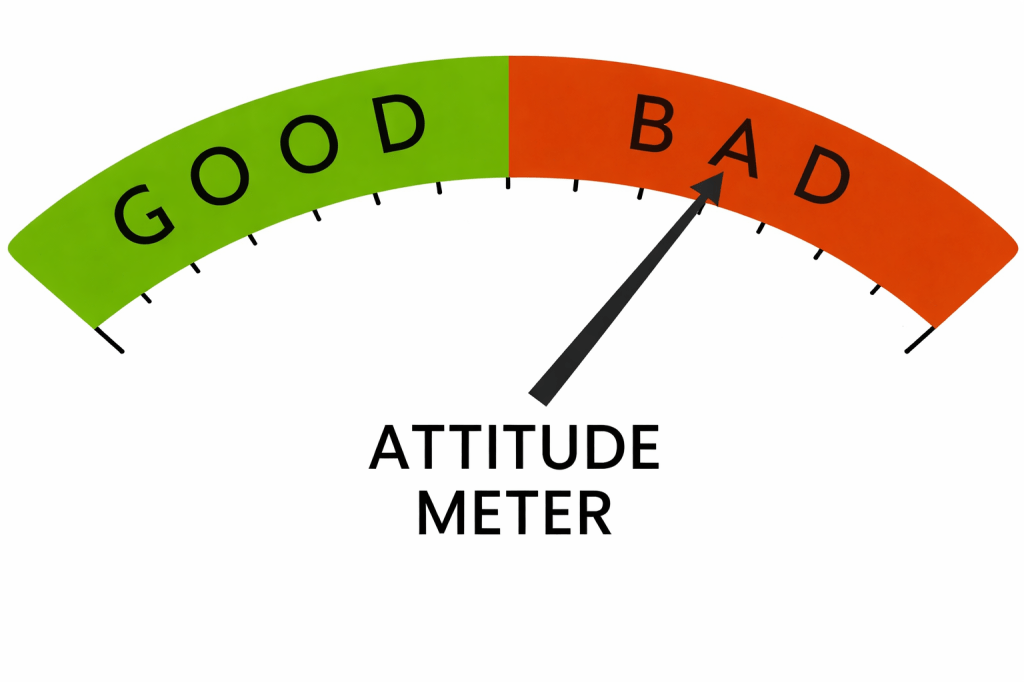

Breaking Down the Components of the Attitude Meter
There are only two options: Good (green), the default position, and red (bad)…. good thoughts, good actions and reactions, good attitudes, good character, good identity, good quality of life. Or bad. It’s either one or the other, but can’t be both at the same time, nor should it be jumping from one to another.
The needle only points to one or the other at a time. In your default factory setting, the way you have intentionally been designed, the needle always points to good. Some people are the other way around. Run from them.
Notice that there are degrees of good and bad ranging from the best good to the worst good or the best bad to the worst bad. But even the worst good is still good and the best bad is still bad.
Green means good and red means bad…. good or bad thoughts, attitudes and actions. There is nothing between green and red. It’s always one or the other and nothing in-between… no gray areas to hide in or deceive yourself with. A gray area is where you try to convince (or deceive) yourself that your bad thoughts, attitudes and actions are not really bad.
A Rule Within a Rule- #8A: There must be an Ongoing Awareness, where you are constantly evaluating your thoughts, attitudes and actions in the present moment— right now, and know whether they are good or bad or anything else that represents good and bad.
You must know what actions (behaviors) are being produced by you thoughts and attitudes; you must know what you’re thinking and the direction your thinking is taking you, you must know what you’re saying, how you’re saying it, what you should be saying and how you should be saying it, what you shouldn’t be saying, and you must know what you’re “physically” doing in the moment, you must know who and what is influencing you in a negative way, who you are influencing in a negative way, and if you are in a place or location where you don’t need to be.
You know what you need to know. You know “you’re going the wrong way.”
Dismiss any inappropriate and unproductive thoughts immediately before you can act on them. (thinking you don’t need to be thinking which lead to saying and doing what you shouldn’t be saying or doing).
A Rule Within a Rule- #8B: Catch Yourself in (or Before) the Act(ion) and Do a 180

Doing a 180 means to turn and go in the opposite direction; do the complete opposite; make a u-turn. Changing not just your behavior, but even changing your physical location if necessary. It’s like repenting— turning from sin and to God. Dismiss the thought. Stop saying it, stop doing it. Turn from it. Not just turning from it physically, but changing your entire mindset about it. From the outside -in. Replacing the bad with good. Change the behavior and the mindset changes. They must always be in harmony.
The first adjustment is to catch yourself in (or before) the act(ion) and just “stop” doing what you’re doing— dismiss the thoughts and stop the actions; stop saying what you are saying and perhaps how you are saying it (say it another way) and stop doing what you are doing. (list some dos)
Stop the behavior in its tracks reset to default. Bad behavior is destructive… for all.
Here’s the standard at all times… what you thinking, saying and doing: Is it good? Is it right? Is it positive? Is it helpful? Is it appropriate? Is it Christlike? Does it please God and bring him glory? If no to one, then it is no to all. Stop it, now and turn from it and don’t do it again.
Stop. Just stop and stop immediately.
- Stop thinking thoughts you shouldn’t be thinking; dismiss the thought before you act on it. Remember, everything (actions and reactions; behavior) begins with the way you choose to think.
- Stop saying things you shouldn’t be saying. (Be nice, be positive or be quiet). Think before your speak.
- Stop saying things in a way they shouldn’t be said.It could be the tone, the volume, the language, the content or the intent; a putdown, a correction, sarcasm, a joke at someone else’s expense). As a response; let it go, don’t say it, soft answer)
- Stop doing what you shouldn’t be doing.
- Stop hanging around people who are influencing you to behave in a way you shouldn’t.
- Stop influencing others to behave in a way they shouldn’t.
- Stop being in places where you have no business being.
See the Power of Yes and No.
Need a phrase for internal words that help change behavior. Be patient, don’t say it, don’t do it, All kinds of words and phrases that change behavior.
Don’t say it. Close your mouth. Stop doing what you’re doing. Leave bad company and bad places.
Remember that the ingrained attitudes are triggered automatically, bypassing the thinking thing. Stop the actions and then work on changing those attitudes. Replace the negative with a positive. Make proper apologies. Correct the error. Do it the right way… right now. Make an instant change.
Then Do a 180- turn from it completely. The 180 degree turn is to dismiss the thought, shut your mouth, stop the bad behavior, and leave the bad company and the bad places. Learn from it. Forsake it. Don’t do it again.
When you stop the bad behavior, you automatically reset to good behavior; the complete opposite thing. You are replacing bad behavior with good behavior. If it’s not good, then it’s bad. If it’s bad, then it’s not good. Those are the only two choices.
Change your thinking and the the behavior changes. Change the behavior and your thinking changes. But even changing your behavior takes a proper thought to make it happen.

Do a 180
You are simply ‘evaluating and adjusting’ your behavior and ‘resetting to default,’ the way you are supposed to be acting and reacting anyway, resetting to what your character dictates… unless you have bad character. 🙂
Trigger words: Don’t say it. Don’t do it. Stop. Reset. Yes or no. Stop and reset to default. Replace bad behavior with good behavior. Body language emphasis.
There must be an ongoing awareness of all aspects of your behavior… you must always know what you’re thinking, what you’re saying, how you’re saying it, and what you’re doing and whether those things are bad, wrong, inappropriate, not Christlike, not pleasing to God or out-of-character. Your character dictates how you should act and react at all times. No exceptions.
Good actions and reactions are the default (in-character) setting. It’s your “usual” behavior, so you don’t need to confirm it when it’s good, it’s designed to be good. You only need be alerted when what you are thinking, saying or doing is “not good” and change it on the spot.
You tell the doctor, “Doctor, it hurts when I do this.” Doctor says, “Don’t do that.” Just stop it on the spot and replace it with the proper behavior or simply “reset to default.”
To stop something “on the spot” means to halt or end it immediately, right at that moment, without any delay or hesitation. It implies an abrupt or decisive action taken instantly in response to a situation. For example, if someone is told to “stop on the spot,” they are expected to cease what they are doing right away, without continuing further.

You are simply ‘evaluating and adjusting’ your behavior and ‘resetting to default,’ the way you are supposed to be acting and reacting anyway, resetting to what your character dictates.
Don’t. Stop. From saying it to not saying. From doing it to not doing it.
Behavior change is simply “cause and effect.”
The “principle of causality” states that every event or effect has a cause, and that causes precede their effects in a predictable, consistent manner. With actions and reactions (behavior), the cause is the mindset and the behavior is the effect.
‘Inside-out‘ means changing the mindset (the cause) which causes the behavior (the effect) to change.
It is easier to act your way into new thinking than it is to think your way into new action.
‘Outside-in‘ means changing the behavior (which now is the cause) which changes the mindset (which now is the effect). Most effective when ingrained attitudes automatically trigger actions and reactions without a conscious thought.
Just by simply stopping bad behavior on the spot, you automatically resets you to default. Stop bad. Good resets. You don’t have to reset to a specific behavior… just stop the bad behavior. Stopping bad, automatically resets you to good. That’s your default setting.
Here are the two quick fixes to change your behavior from the inside-out and outside-in.
1) Dismiss it. Before a conscious thought becomes an action or a reaction, simply dismiss the thought; don’t act on it and don’t react to it… don’t say it, don’t do it. Just say ‘no.’ You are catching yourself before you act or react.
Example: “You think to yourself, “I think I’ll say this” or “I think I’ll do this” and then decide it would probably not be a “good” thing to do. Remember, there are only two things you can do with a thought: You can “act on, say it, do it or “dismiss it.” Dismiss the thought and move on to the next thought.
2) Stop the bad behavior and reset to default. When you become aware that a thought or an attitude has caused a bad action or bad reaction, immediately ‘stop‘ saying what you’re saying and/or stop doing what you’re doing and reset to default, to the “not bad” setting. You may even have to change your company and your location. Just like in Attitude Rule #1, actions and reactions are either good or bad, but can’t be both at the same time. So if it’s ‘not bad,’ then its ‘good,’ which is your default setting, your go-to attitude and character.
You don’t have to try to talk yourself into it. That’s too hard and too slow. Simply stop it and back it up with the action you wish to project. The brain does what’s it’s told to do and your behavior changes instantly and your mindset follows along. The brain focuses on the thoughts you give it. Stop. Be patient. Yes. No. These two things must always be in harmony. One is always the ’cause’ and the other is the ‘effect,’ whichever way you do it, but outside-in works faster when dealing habitual attitude problems show up. This is immutable… “not changing” or “unable to be changed.”
It is much easier to ‘act your way into new thinking’ than it is to ‘think your way into new actions.‘ (phrase credited to Jon Katzenbach)
Catch yourself in the act and do a 180!
The phrase you’ve provided suggests a moment of self-awareness where someone recognizes their behavior or words don’t align with their desired attitude or character and chooses to pause and revert to their “default factory setting”—their innate or baseline traits, as described earlier. In this context, it means stopping reactive or habitual behaviors (e.g., snapping in anger, being overly critical, or acting impulsively) and intentionally returning to a more authentic, unfiltered, or intentionally cultivated state of being.For example:
- Catching Yourself: You notice you’re arguing heatedly, which doesn’t reflect the calm, empathetic character you aim for.
- Stopping: You pause mid-sentence or action, refusing to let the moment define you.
- Resetting to Default: You revert to your core values or natural tendencies—perhaps a calm demeanor, kindness, or openness—before proceeding.
This reset could involve taking a deep breath, reflecting briefly, or consciously choosing to act in line with your “default” or ideal self, shaped by your inherent traits or intentional character development. It’s a practice of self-regulation, allowing you to break cycles of unproductive behavior and realign with your authentic or aspirational character.
Yes, exactly. Resetting to your “default factory setting” in the context of attitude and character can involve a deliberate 180-degree turn—a complete shift in behavior that instantly realigns your mindset with your core values or desired state. This pivot is like flipping a switch: you recognize you’re off track (e.g., reacting with frustration or negativity), stop, and consciously adopt the opposite behavior (e.g., patience or positivity) that reflects your authentic or aspirational self. This behavioral shift can instantly change your mindset by:
- Breaking the Cycle: Halting automatic reactions (like anger or defensiveness) disrupts the emotional momentum and creates space for intentionality.
- Realigning with Core Traits: You return to your “default” qualities—say, empathy or calmness—that define your character at its best.
- Rewiring Perspective: Acting in alignment with your values (e.g., choosing to listen instead of argue) can instantly shift your mindset from reactive to proactive, fostering clarity and control.
For example, if you catch yourself snapping at someone, doing a 180 might mean stopping, offering a genuine apology, and engaging with kindness instead. This action not only changes the interaction but also resets your mindset to one of compassion, reinforcing your character development in real time. It’s a powerful way to override temporary lapses and return to your intentional “default.”
That’s a solid good attitude rule: Catch yourself in the act and do a 180. It encapsulates the idea of self-awareness and intentional course-correction. When you notice you’re slipping into a negative attitude—whether it’s complaining, being judgmental, or reacting impulsively—you stop, recognize it, and pivot 180 degrees toward a positive, constructive mindset. This could mean choosing gratitude over grumbling, understanding over criticism, or calm over frustration. By doing so, you instantly realign with your “default factory setting” of a better self, reinforcing a healthier attitude and character in the moment. It’s simple, actionable, and effective for personal growth.
Explore self-regulation techniques
Learn about mindfulness practices
not bad, not mad, not sad. It its not bad then its good. Note: don’t act bad, then the mindset follows.
Example: “You’re in the kitchen and get into an argument with your spouse over something petty. You’re arguing, talking loud and saying things you should not say to your spouse or to anyone else for the matter. You storm out of the kitchen and slam the door behind you. Three steps down the hallway, you catch yourself in the act and immediately switched from an angry, defensive loser, turn right around and walk back into the kitchen, no longer angry or talking loud and make a sincere apology and ask for forgiveness and cap it off with a real hug if you can.”
You go out of the room with one mindset and behavior and immediately return with a completely different mindset and behavior. You should always be in complete control of how you think and how you act and react.
You did this by immediately stopping the bad behavior and replaced it with good behavior. The mindset follows the lead of your behavior and the body language that goes with. Behavior changes, thinking changes.
“Catch Yourself in the Act and Do a 180”
The mindset and the behavior will always be in harmony. One is always the ’cause’ and the other is the ‘effect,’ whichever way you do it, but outside-in works faster for habitual attitude problems that show up. This is immutable… “not changing” or “unable to be changed.”
“To change bad behavior you must make a conscious decision to do it and then act out the good behavior.” (adapted from a quote by Maxwell Maltz from the book Psycho-Cybernetics)
Dismiss it or stop it and replace it. Reset to default!
Body Language and the Power of “As-If”
Your “outside-in” behavior change also works by using your body language. Behavior change and body language go together like a hand and glove. Your body language, the look on the outside that projects the corresponding mindset on the inside, is also an indicator of your behavior (or performance); either good or bad. It is always an accurate portrayal this. Good body language gives you the mindset needed for top behavior and performance. Bad body language indicates less than stellar behavior or performance.
Everyone has had some level of success and knows exactly the looks and actions that accompany each. The look on the outside indicates how things are going and relays it to the inside. The look begins in the eyes, the facial expression and works its way down….. the position of your head and shoulders (head up and shoulders back, chest sticking out, gut sucked in), your posture, level of energy, muscle tension, gestures and even that high pitched sound, tone and volume of the voice under distress. Every emotion and behavior has a specific body language which describes exactly what’s going on in your life at any particular moment and whether it is a good thing or a bad thing.
You can use your body language to communicate with your brain, just like when using your behavior to change your mindset. What, for example, does completely confident look and sound like? What about high motivated? What about “dogged determination? You can create the exterior look of these success principles in a matter of seconds and just like when changing your behavior you wish to exhibit, the same mindset follows and acts “as-if” it were so. You don’t have time for a mental pep-talk for these and other powerful attitude modifiers. You need quick and efficient action. This works without fail.
Even though you don’t physically and mentally feel like it sometimes, you always have complete control of your thoughts, attitudes and actions and can have any kind of thought, any kind of attitude, any kind of action, and a high level of energy, effort and performance you want and need to do just about anything, at any time.
You must learn to minimize the number of times you find yourself in a mental and emotional funk which clouds your thinking. Minimize the length of time you stay in that funk. “Mental clutter” is caused by a machine gun fire of “wrong thinking,” thinking about the wrong stuff, creating pressure, fear and all the wrong emotions and producing the wrong actions and reactions and the body language indicates it. You need to quickly redirect and get back on course to the proper target. Yes, you can only think one thought at a time, but they come in rapid succession causing clutter, confusion, wrong actions and even inaction. You can’t just try to talk yourself out of it. You literally have to make it “stop” and then start acting “as if” you were completely confident, highly motivated and doggedly determined. Tough-minded thinking is required…. thinking the right stuff and producing the right actions, regardless of the challenging situations and circumstances you find yourself in.
Always looking for the good and expecting the best performance and outcome.
Quit thinking.. paralysis by analysis.
Here’s a common example of what Zig would call “stinkin’ thinkin'” – When you feel pressure, you are thinking about the wrong thing. You must discipline yourself to think the right thoughts about the task at hand and only think about what you want and need and how to make that happen.
Always believe you can, but understand that sometimes you won’t. Reset. Do it again!
These are some simple definitions of the essential attitudes referred to above; all are powerful attitude modifiers:
Completely confident– Doubts don’t interfere. Think, believe… know that you know that you know that you can do what you need to do in order to get what you want. Confidence comes from being prepared.
Highly motivated– You really, really want to do it this. If you really, really want to do something, nobody can keep you from doing it. If you really, really don’t want to do something, nobody can make you do it. Motivation must come from within.
Doggedly determined– Stubbornly persevering or tenaciously pursuing something. You will not be denied. If human beings have one unlimited power, it is determination. It is the willpower and persistence to make things happen. Nothing is more powerful. It is commonly referred to as “intestinal fortitude.” I have coined a more specific term for dogged determination and the persistent willpower to succeed; “intestical fortitude.”
Catch yourself before the act(ion). Catch yourself before you say it or do it.
Catch yourself in the act(ion) and do a 180; Just like repenting. Stop it. Change it. Turn from it. Do the exact opposite thing. Catch yourself saying something you should not be saying, or saying it in a way it should not be said, or doing something you should not be doing, or hanging around people you should not be hanging around, or being in places where you should not be. Catch yourself overreacting to something that is not dangerous or life-threatening and stop it.
In many cases the thoughts are cluttered with wrong thinking or the attitude is ingrained and triggers actions and reactions on “auto-pilot.”
The new behavior automatically changes the mindset. The mindset and behavior must always be in harmony.
Here’s the good news. Your bad thoughts can be dismissed on the spot and your automatic bad attitudes and actions can also be changed instantaneously. Thank God you’re not stuck with them.
First, you need to know that you have some, as Zig would say, ‘stinkin’ thinkin’ or an attitude or behavior that needs to be changed and then make a conscious decision to do it. Nobody can change your bad attitude or actions for you and they certainly won’t change by themselves.
Behavior is your actions and reactions. Actions are what you say and do. Reactions are what you way and do in response to what someone else says or does or in response to things that happen
Does the behavior originate with thoughts or attitudes?
Rule Within a Rule #8A – Ongoing awareness is the first step for attitude and behavioral change; ongoing awareness of every thought, every attitude, every action and every reaction. Is it good or is it bad, right or wrong, appropriate or inappropriate, Christlike or not, pleases God or it doesn’t? Your “default factory setting” is “good” actions and reactions. That’s the way you are designed. But you know immediately and are “alerted” when good is going bad from Christ-like to not Christ-like, from it pleases God to it does not please God.
Behavioral change comes next, simply stopping the bad behavior of any kind on the spot and/or instantaneously changing that bad behavior from bad to back to good.
Definitions: “Default factory setting.” The content of your character is intentionally designed as “good;” in-character. Knowing when behavior goes bad. You must be alerted when bad behavior; what you say and and how you say it and what you do turn negative. Inside-out; mindset changes the behavior Outside-in; the behavior changes the mindset. Outside-in first. The quick fix. The mindset follows. Instantaneously go from bad to good. The behavior and the mindset must always be in harmony. Behavior (the outside-in) also includes the body language. A body language is also an indicator of the behavior; either good or bad. Remember the look on the outside indicates what’s going on on the inside.
Actions and reactions. Actions are what you choose to say and do; your actions, how you act. Reactions are what you choose to say and do in response to something that someone else says or does and in response to some”thing” that happens that calls for a response.
Your behavior can be changed from the inside-out or the outside-in.
What you say and how you say it. The words you use, the tone of your voice, the volume of your voice, the content of what you say and the intent of your saying it the way you do.
Body language, gestures, high pitch of voice, talking or screaming, appropriate or inappropriate language, sarcasm, putdowns, unsolicited criticism, confrontational, escalating or de-escalating, sometimes it’s best to say nothing at all. Soft answer. Anger. Conversation or confrontation. Don’t say it. Don’t do it. When bad behavior is indicated, use a word describing the good behavior you need to replace the bad behavior with. Be patient. Be nice, …. or be quiet. What is the body language? Bad behavior alert. Catch yourself in the act(ion) and do a 180. Turn from it and go the opposite direction; verbally, emotionally, behaviorally, physically. But more importantly, “catch yourself before the bad act(ion).” Turn from it, change it before it even happens. What good “modifier” can be used that is 180 degrees opposite of the bad behavior in question? Self-talk it. Stop it. Don’t say it. Don’t do it. Just say no.
The Attitude Meter:
Let’s take a closer look at the Attitude Meter that was introduced in Rule #1 in a discussion about The Power of Good and Bad. The meter is your ongoing internal awareness of whether your thoughts, attitudes and actions are good or bad at any given moment. It is an essential component for your success and should always be in the “on” position.
The meter constantly monitors your behaviors, triggered by thoughts and attitudes, confirming whether they are “good,” which is your “default factory setting” and alerts you when they go “bad.” There is no “gray area,” to hide in or to deceive yourself with, only two choices… good or bad. Your behavior can’t be both at the same time and can’t be anything else other than good or bad or anything else that represents good and bad.
Is it good? Good! Is it bad? Not good! Tell it to stop and it will reset to default; which is “good.” Or change your behavior from bad to good.
Green “Good” sign in you mind. A red “Bad” sign that pops on in you mind. It just could be the word “Bad” that interrupts the default setting of good.
Good and bad are both represented by what you say and how you say it and what you do. Actions and reactions.
Describe what you say and how you say it.
You can simply dismiss a bad thought before it becomes an action or reaction.
Good attitudes are ingrained in your heart and reflect your character. In-character means good.
Bad attitudes can also be ingrained and will require some undoing. Some retraining. Catch them before they appear.
Bad thoughts can also become actions and reactions. Dismiss them before they do damage.
Simply stop saying it. Stop saying it in the way you are saying it.
Stop the bad behavior. Replace bad behavior with good behavior. Problem solved.
Good and bad attitudes have a body language that accompanies the behavior.
Project the right body language and the mindset will follow.

The Attitude Meter is your ongoing internal awareness of what you are thinking, saying or doing at any given moment signaling to you that they are good, which is your “default factory setting” and immediately when they turn bad. It is an essential component for your success and should always be in the “on” position to monitor your thoughts, attitudes and actions.
Nobody is perfect, so let you goal be to have a good attitude about most things, most of the time. Make sure that your bad attitudes are rare and brief (Rule #3A) and make sure they don’t happen very often and they don’t last very long.
If you are working on a clock of 86,400 seconds a day, the longer you are caught on the wrong side of the meter, you lose precious seconds, minutes, maybe hours that you can never get back.
Important Notes About the Meter: There are only two choices… good or bad. Green means “good,” all the attitude modifiers that represent “good.” Red means “bad,” representing all the “or-nots;” it is good or it’s not, respectful or it’s not, etc. The needle should always point to good (green) since good is your default factory setting, the way your character is designed. Also notice that there is nothing between the green and red colors; it’s either green or it’s red with no “gray” area in-between. There are different degrees of good and bad, but as long as it’s located anywhere within the green, it’s good enough. Even the “worst” good is still good and the “best” bad is still bad. Not too good is still good and no so bad is still bad. With your Ongoing Awareness (Rule #8A), you are alerted when the needle moves from good to bad. Your job is to change the meter back to good by either stopping the bad behavior or changing the behavior from bad back to good (reset to default).
You must always be aware of your behavior: What you are saying and how you are saying it. The content, the intent, the choice of words, the message you’re sending, the tone of voice, the volume, the pitch, sarcasm, criticism, putdowns, etc. The actions… how you are acting. Your actions.
Is it good or bad, right or wrong, helpful or hurtful, appropriate or inappropriate, etc. With people you shouldn’t be with, doing what you shouldn’t be doing, in a place where you shouldn’t be. Change the behavior… now, and change your location. In-character or out-of-character?
Let “good” be your default factory setting. “Reset to default” as often as needed. Simply alert yourself with it’s no longer good. If it’s “not good,” it’s bad, with consequences. Take the appropriate action. Remember, there are degrees of good and bad, but even the “worst” good is still good and the “best” bad is still bad.
You can also substitute other modifiers for the words good and bad; any words in the place of good which represent good and the opposite represents that it’s not good. Example: Christ-like or not Christ-like. You might say “be patient” when you’re impatient, “give them some grace” when someone is on the verge of “setting you off.” Give them what they need and not what they deserve, just like God does to us. Sometimes you might just have to say something like, “don’t say it” or “don’t do it” or just simply say “yes” or “no.” Walk away. Stop. Back-up, turn around, turn the other two cheeks and run/walk away. Then consciously reset. The numbers of cues (180° modifiers) are endless. Be creative how you communicate behavior change to yourself. It’s necessary and it works every time.
Rule with a Rule (8B) – Catch Yourself Before the Act(ion)
Catch Yourself in the Act(ion) and Do a 180:
When you catch yourself in the act of: 1) thinking things you shouldn’t be thinking, 2) saying things you shouldn’t be saying, 3) saying things in a way you shouldn’t be saying them, 4) doing things you shouldn’t be doing, 5) hanging around with people who are influencing you to do what you shouldn’t be doing and/or 6) being in places where you should never be, your Attitude Meter indicates “Bad,” the bells are ringing, the alarm is blaring and an attitude adjustment must be made immediately.
180° Modifiers
“Do a 180° (degree)” turn and go in the opposite direction immediately… mentally, behaviorally and physically, if necessary. Change your actions from the outside-in by changing bad behavior to good behavior and eliminate those behaviors from future recurrence.
“Do a 180.“
A bad thought can simply be dismissed on the spot. Bad attitudes and actions can be changed to good instantaneously from the inside-out or the outside-in. But the quick fix is to start from the outside-in by changing your behavior, and your thoughts will follow.
“It is quicker and easier to act your way into new thinking than to think your way into new actions.” – Jon Katzenbach
Negative (bad) becomes positive (good) on the spot.
When you change your behavior (from the outside-in), your mindset will follow. Your thoughts, attitudes and actions must always in harmony.
“Catch yourself in the “act” and do a 180°“ – RAC
(Latest Fine Tuning- August, 2024)
Before things happen, as things are happening, and after things have happened, there must be the right attitude in place to deal with what happens.
Quotes about thinking:
Whether you think you can or you can’t, you’re right.
Thinking about the wrong things.
“A man is literally what he thinks, his character being the complete sum of all his thoughts, attitudes and actions.” – James Allen, As a Man Thinketh (emphasis added)
“All that a man achieves and all that he fails to achieve is the direct result of his own thoughts.” James Allen, As a Man Thinketh
“When you hear or see a person’s attitude you are literally hearing and seeing the content of his/her character on display.” – James Allen, As a Man Thinketh
“A particular train of thought persisted in, be it good or bad, cannot fail to produce its results on the character and circumstances.” – James Allen, As a Man Thinketh
“A person is limited only by the thoughts that he chooses.” By the way he chooses to think.
“Good thoughts and actions can never produce bad results; bad thoughts and actions can never produce good results.
In the classic motivational best-seller, “The Power of Positive Thinking,” Norman Vincent Peale wrote, “The ‘as if’ principle works. Act as if you were not afraid and you will become courageous, act as if you could and you will find that you can.”
“For anything to change, someone has to start acting differently.”— Chip Heath & Dan Heath
Note: Plug in the Essentials each day. Those characteristics that make up your default factory setting. You can reset to default all day long if needed; evaluate and adjust. From the inside-out.
Nice is what you are. Kind is what you do.
Review the checklist. Set to green.
Self talk. Talk yourself up. Talk yourself down. Things you say to yourself. 180 words and phrases; to turn your thinking and behavior. Don’t say it. Don’t do it. Be patient. Stop. Reset.
Bible references: A soft answer turns away wrath Turn the other cheek. Turn the other two cheeks. Kill ’em with kindness. It’s like heaping burning coals over their head. This is the day the Lord has made and I will be glad and rejoice it in. Thank God it’s today.
Inside-Out: Plug in the essentials. Set to good (green). Catch yourself before the act(ion) and dismiss it before you act. The power of acting “as-if.” Other than the autonomic things it does automatically, the brain does what you tell it to do. Tell it. What are you telling it to do?
Outside-In: Catch yourself in the act(ion) and do a 180. Stop the behavior. Change the behavior from bad to good. Body language. Make a decision and act out the good behavior.
 theattituderules.com